
Peer-reviewed articles
Tifinagh as a Reading of the World: Tuareg Perspectives
AUTHOR: Hélène Claudot-Hawad
Tifinagh as a Reading of the World: Tuareg Perspectives[1]
Hélène Claudot-Hawad
CNRS (Anthropologist, Honorary Research Director)
Abstract: Tifinagh (feminine plural) are more than just an alphabet, as evidenced by the uses and interpretations of this sign system by the Tuareg people. The Tuareg place Tifinagh and their graphic forms, organized into families of signs, into a cognitive model and a meaningful framework. In the present analysis, the examples given show the loss of meaning produced by the alphabetical trivialization of Tifinagh signs, and the “de-Berberization” or “de-Amazighization” resulting from the fanciful graphic design of neo-Tifinagh.
Keywords: Tifinagh; system of signs; contemporary users; Amazigh; Amajagh; Amahagh; Amashagh; Tuareg; Central Sahara; graphical logic of Tuareg Tifinagh; cosmovision; non-alphabetic functions of Tifinagh; neo-Tifinagh; loss of graphical logic of Tifinagh.
Simplified notation used
and correspondence with the international alphabet
e, é, gh, sh, kh, dj, D, T, Z / ⴵ , e, ɣ, c, x, ǧ, ḍ, ṭ, ẓ
Tifinagh are more than just an alphabet, as linguist Salem Chaker notes in his recent comprehensive work Diachronie berbère, Linguistique historique et libyque (2024). In the chapter dedicated to Libyco-Berber writing (pp. 189-192), Chaker examines the early disappearance of Tifinagh in the northern part of the Berber/Amazigh world between 6-8 C.E. The remarkable continuity of this system of signs, from its prehistoric beginnings up to its usages today, is culturally unique to the Amazigh·s of the central Sahara and its Sahelian borderlands, who refer to themselves as Amahagh·s, Amajagh·s, or Amashagh·s[2] (referred to by others as the “Tuareg”). Chaker has emphasized just how involved Tifinagh (feminine plural noun) are in this context “of extremely strong socio-symbolic values,” taking on “an essentially playful (messages of love, language games) and symbolic (marks of ownership, signatures) function,” with usage “having been and remaining limited to the composition of short messages.”[3]
This begs the question: How could Tifinagh, which have been shown to have existed in their current—that is, decodable—form since at least 5 C.E.,[4] have survived among the Amahagh·s for more than sixteen centuries if their usage is so limited? And this doesn’t even account for their connection with ancient Tifinagh or Libyco-Berber signs that are indecipherable today and that could date back to between 800 and 500 B.C.E.
What and Who in the Tuareg Community Did this Writing Serve?
Oral expression has certainly been favored for the transmission of myths, tales, history, law, and poetry. It is important to keep in mind, however, that research into the use of Tifinagh in various fields remains incomplete. For example, correspondence in the Tuareg region takes place on various media (leather, bone, paper) but is rarely preserved.[5] The very specific way that letters sent throughout this vast territory are folded also shows a shared and probably ancient practice for this type of exchange. Moreover, the Tuareg caravanners, merchants, artisans, and jewelers still frequently use Tifinagh today to list their commercial activities. There are inscriptions and signatures on jewelry worn by the men (stone arm bracelets) and women, and on all the important protective objects—in the past, on shields, for example. More intensive use of the alphabet has been seen among specialists, for example traditional healers such as Lama of the Ikazkazen of the Ayer (Aïr), who wrote down her observations and medications in Tifinagh, which she herself vocalized, in the 1940s-50s. In terms of books, there are numerous commentaries written in Tifinagh in the margins of philosophical and theological works in Arabic that were studied in Tuareg Sufi centers. There are, however, no epitaphic inscriptions in Tifinagh (or in any script, for that matter) on Tuareg tombs, which is consistent with the idea that speaking or writing the name of the deceased would be tantamount to bringing them back among the living and interrupting their journey in the sphere of the invisible.
One striking feature in the Tuaregs’ use of Tifinagh is the intimate relationship that spontaneously arises between these signs and the engraved, incised, painted, and embroidered geometric patterns adorning both every-day and prestigious objects in the material environment. From this perspective, the Tifinagh and their graphic forms respond to an aesthetic logic—and even more so to an expressive necessity—that has its own rules and is the same as for the decoration of Tuareg materials. I will return to this crucial connection later, since it seems to play a vital role in the continuity of Tifinagh, the ways it is understood, and how it is used to this day.
Tifinagh Variants
Several variants are to be found across time and space, as pointed out by Chaker,[6] who refers to different authors who have noted that “each confederation uses an alphabet that is slightly different from that of the neighboring groups.” These variations have sometimes led to the assumption that there are Tifinagh for strictly local use. Yet only three to five letters change, and these forms of signs are easily interreadable. This likewise applies to the phonetic variants h, j, and sh in Tamahaght, Tamajaght and Tamashaght, or the three variants, or “sides”—literally, the “flanks” (tédést, tidésen)—of the language that the Amahagh·s distinguish. It is important to avoid the pitfall of considering these variations from a sedentary perspective, a tendency illustrated by a linguistic map published on website of the Institut national des langues et civilisations orientales (INALCO),[7] where the Tuareg linguistic area is shown to be divided into nine little distinct dialectal islands. These islands, according to the names given to them, are separated based on disparate criteria, some relating to geography (Tayert, Tadghaght, Tahaggart, etc.), others to clan or confederal social affiliation (Tawllemedt, Tamesgerest), and others to social hierarchy. Thus the Ineslimen—literally, the “Muslims,” or religious ones—are designated as speaking Taneslimt, or “Muslim,” a dialectical variant that is imagined to differ from those of other social categories.[8] While it seems possible here to speak of “language levels” (in the sense that the linguist Georges Mounin uses to describe,[9] for example, certain particular uses of a language depending on the social environment), it would be irrelevant here to establish a dialectical boundary. It is important to note, however, that there are regions (such as the Ayer and Tademekkat) where several dialectical forms co-exist, and such a situation leads to another line of questioning: Why do these differences—phonetic and sometimes phonological or even lexical—persist even though they are so close together?
In fact, the Amahagh·s exhibit a marked preference for diversity, or what might be called the “shimmering" of the world. From this viewpoint, a multiplicity of ways of being and speaking is considered graceful, inspiring, and stimulating, whereas uniformity is perceived as monotonous and likely to leave language static and frozen. It could be posited that the polycentric sociopolitical and cultural organization of the Tuareg has encouraged the maintenance of these linguistic distinctions, contrary to the ideal of centralized models that seek to “normalize” or “standardize,” i.e., to unify culture or language by eradicating all local particularities.
Neo-Tifinagh
Chaker mentioned a “renaissance of the old Berber alphabet, used in a highly modernized version for the customary notation of Kabyle” among the Berbers of the north.[10] The first neo-Tifinagh were created in Kabylia in the 1970s by activists at the Académie Berbère, who modified the form of several Tifinagh signs and added a dozen additional characters to bring the total for the notation of Kabyle to thirty-seven.[11] Building on a linguistic approach, in 1989 Chaker proposed a “standard Libyco-Berber alphabet” that didn’t “introduce a single new letter compared to traditional usage (Libyc and Tifinagh)” (Chaker 1994, p. 34). Priority was given to the phonological function of the signs, making it possible to reduce the number of signs in this version of neo-Tifinagh, which aimed to graphically represent all Amazigh dialects. The historical and linguistic logic of this alphabet contrasts with the neo-Tifinagh of the Académie Berbère.
A problem remains, however. These neo-Tifinagh characters borrow their forms from registers that are culturally connected but still heterogeneous in terms of temporality and spatiality. The signs used are drawn in part from the eastern Libyc repertoire, which stopped being used more than a millennium ago, and in part from the Tuareg Tifinagh from Ahaggar, which are still very much alive. The set combines 12 Libyc and 13 Tifinagh signs, not counting the repurposing of existing forms that new values are attributed to for the notation of the vowels u and i and certain emphatic consonants that don’t exist in Tuareg. Ultimately, this “patchwork” alphabet made up of 29 letters is significantly different from the only contemporary Tifinagh system, which is used by the Amahagh-s.
In the 2000s, the process of recognizing Amazigh as a national language—with its constitutional status as a “national and official language” not formalized until 2011 in Morocco and 2016 in Algeria—raised the question about which writing system was to be adopted.[12] Among a variety of options (Arabic, Latin, and Tifinagh), it was the third that prevailed in Morocco. In 2001, the Institut Royal de la Culture Amazighe (IRCAM) adopted the neo-Tifinagh model of the Académie berbère to write “standard Moroccan Amazigh” with 33 basic signs. Two Libyc and nine Tifinagh signs remain, with the reset being graphical creations made outside historically known repertoires. Ultimately, IRCAM’s basic neo-Tifinagh set included graphic modifications to 17—notably, all the graphs with dots—of the 21-25 letters used by the Tuareg, or 70-80% of the signs. Some Tifinagh forms reappear in IRCAM’s extended set but still do not make it possible to recreate a coherent set of signs that would allow the Tuareg to use this reconstructed alphabet.
It has been observed that from the 1970s to the 2000s, most attempts among Amazigh·s of the north to reappropriate Tifinagh have endeavored to reshape or replace various signs which, despite being rooted in a long history, have remained in use among the Amahagh·s. What need could this recurring concern about graphic reform have responded to? At a time when writing was still frequently a matter of putting pen to paper, the elimination of all letters with dots, which were easy to draw in a single stroke on loose material such as sand, could be interpreted as a simplification of the hand movement. But one to two decades later in the age of computers, when a single keystroke is all it takes to produce a character, this can no longer be a determining factor. Another problem that was evoked: the possible confusion created by the succession of punctiform signs or those with vertical lines, though Tuareg writing resolved this with the slight difference in graphical forms. The argument advanced to legitimize the modification of characters conveys the recurring idea of making writing more “practical,” more “functional,” and more “rational.” Accordingly, a text that IRCAM published in 2004 notes four criteria for defining the “modernization” of Tifinagh, namely: “historicity, simplicity, univocity of the sign, and economy.”[13]
These operations are considered through an evolutionist lens. The developmentalist discourse associated with them implies that the Tifinagh signs used by the Amahagh·s are archaic even though they are contemporary, which leads them to be downgraded. This type of approach is based on an implicit hierarchization of knowledge and has produced a fracture between the living writing of the Tuareg, which has been relegated to a bygone era, and the neo-Tifinagh born of the “laboratory” that is supposed to be the embodiment of “modernity.” Here can be seen a form of “cultural cannibalism” associated with the reformist appropriation of a writing system, without consulting with its users.
The recognition of neo-Tifinagh—tacit in Algeria and official in Morocco and the Amazighophone region of Libya—offered this alphabet high visibility in Tamazgha’s cultural and educational domains and media, despite some political obstacles and reluctance at the local level. In becoming official, neo-Tifinagh also became more diverse as each authority reorganized the letters and their values based on the respective dialects. The boundaries between nationalized neo-Tifinagh scrips gradually came to overlap with the political and territorial boundaries of the Tamazghan (North African) states. Meanwhile, the Tifinagh signs transmitted and used by the Amahagh·s in the vast, supra-state territory they inhabit (Algeria, Libya, Niger, Mali, Burkina Faso) have been captured, added, eliminated, and transformed like so many “spare parts” at the whim of those who produced neo-Tifinagh, themselves strangers to the practice of this writing system. These efforts, aiming to uphold and promote an original “Amazigh” script, did not account for the integrality or coherency of the signs of Tuareg Tifinagh and did not involve its users keeping it alive.
The Amazigh man of letters and intellectual Mohamed Chafik, the first rector of IRCAM, was one of the first to promote the universal adoption of Tifinagh in Morocco.[14] At a meeting in Barcelona in 2005, Hawad and I asked him why he and his group had chosen to propose neo-Tifinagh to the Moroccan authorities even though this alphabet was designed without any connection to the only contemporary users of Tifinagh, creating a harmful divide in this system of signs that could have become a transnational, collective tool like the Arabic alphabet. He answered us very kindly that it was a “lack of time” that led them to adopt neo-Tifinagh, whose form and usage—initially formed within the Kabyle context—had been picked up and popularized by the Amazigh·s of the north.
Ultimately, the creation of neo-Tifinagh and its subsequent national developments have foregone an essential feature: the specific knowledge and experience of the Amahagh·s who identify with this system of signs well beyond its “modern” standardization as a mere alphabet.
Vocalization
One of the main challenges in “modernizing” Tifinagh was its vocalization. As Chaker explains, “In Berber, vowels play an absolutely fundamental role in lexical distinctions and often even grammatical ones.” This is why “a purely consonantal script is structurally unsuited to Berber.”[15]
In Tuareg country, there have been a variety of experiments with vocalization, some dating back to the first half of the 20th century.[16] These vowel arrangements are linked to different contexts. The first involves scholarly and specialized practices that used Tifinagh more intensively to write down and record medications, contracts, commentaries on texts, and translations from Arabic or Persian. The second context is a political one; it is related to the upheavals in the 1970s connected in the Sahara to the tightening of borders, the expansion of mining under the army’s protection, the despotism of new leaders who were the successors to colonization, and the barriers to pastoral mobility and caravan activities, which were now viewed as illegal because they were crossing borders. The stifling of the nomadic economy meant that young Tuareg could no longer live at home. From this restrictive context there emerged the resistance movement of the ishumar,[17] literally the “unemployed,” a term borrowed from the French “chômeur” and adapted to the syntax of Tuareg to designate the young people driven out of their homes by the destruction or annexation of their lands and wandering secretly across borders looking for work. In addition to the violence that authorities perpetrated against nomads, there were catastrophic droughts of the 1970s and 1980s and local authorities embezzled international aid. This combination of events led many young people quickly into exile as they sought ways to survive and to “liberate the country.”
This period of struggle against the stifling effects of the new states’ sedentary and centralized logic tied in with a flurry of creative activity among the ishumar, who produced many political messages and letters written to those who had stayed back home. Starting in the 1990s, they also used audio cassette recordings to distribute their sung poetry about exile and new theatrical plays about their lives in the margins. It was in response to these new uses of writing that they created five new vowels. They used a pattern that is omnipresent in Tuareg ornamentation: the double triangle with an anthropomorphic silhouette to represent the neutral vowel (e), topped with one or two dots to distinguish between an a and a u (, ); and they built on the sign for the semi-consonant y using the same diacritical process for i and é (, ).[18] Unlike the processes observed in the northern part of Tamazgha, here the vocalization of Tifinagh to facilitate the reading of texts was driven by individuals of nomadic backgrounds who had rejected colonial and neocolonial schooling.
During this same period, the intensive use of vocalized Tifinagh went hand in hand with the birth of poetic, musical registers for guitar, offering new heroic portraits of border-crossers who could be recognized by a changed appearance, such as a turban worn around the neck or wound carelessly around the head. These features are associated with the cultural revolution of the 1970s that accompanied the political suffering of the disrupted, criminalized nomads and the painful exile of the young people, some still children, who had left to learn how to use modern weapons and to “swap blood for knowledge.” Starting in the 1980s, many of those who had signed up for the military in Libya were sent to conflict zones that did not concern them, and where some were to lose their lives.
These young Tuareg built on the knowledge passed down by their society to adapt it to the world that was referred to as “modern”—that is, dominated by Western, state-sponsored, and highly centralized political, economic, and cultural models. Their letters and sung poetry circulated all throughout the Sahara, from the north to the south and from the east to the west and beyond, to communicate the torments of exile and their readiness to fight for their country. Three decades later, the music born of the Tuaregs’ pain and resistance would become internationalized and deprived of its political meaning as the showbiz industry labeled it as “world music,” essentially for the profit of European and American producers.
The Aesopic scenario of the iron pot versus the clay pot as exemplified by the history of ishumar music plays out in another way as regards the Tifinagh, which initially inspired the creation of neo-Tifinagh in regions that had lost the usage of this system of signs. In Morocco, considerable resources have been allocated to cultural and educational institutions for the standardization of the language and alphabet and the production of modern and effective distribution tools such as the creation of a font with Unicode characters.[19] In this system, it’s the neo-Tifinagh form that has become “canonical.” The technological power of this standardization and codification of writing has directly resulted in the marginalization of the Tifinagh signs transmitted and used by the Tuareg in favor of neo-Tifinagh, whose glyphs prevail in most of the current computer applications; in a way, this reproduces the north-south relationship within Tamazgha itself. The neo-Tifinagh graphical form replacing the Tifinagh one poses numerous problems regarding interpretation and usage. For example, it creates confusion between certain neo-Tifinagh letters and existing compound signs in Tifinagh (which have, moreover, been removed from the Unicode system). Likewise, several neo-Tifinagh glyphs established as basic letters replacing Tifinagh (for example, the ⵍ in the place of the ⵍ, or the ⴼ in the place of the ⴼ) are considered unusable by the Tuareg because of the connector added between the initial sign’s vertical lines.[20] The aim here is specifically to understand why this type of modification that may seem visually insignificant and functionally necessary to some may be seen by others as absurd and unacceptable.
Learning and Using Tifinagh
In Tuareg country, the education that children up to the generation born in the 1990s received from a very young age involved using and deciphering Tifinagh. It is worth noting that while the stigmatization of Tifinagh as “the devil’s writing” from a Muslim perspective may have kept some groups from practicing it, most others have turned it around as a prized emblem of identity, love, honor, and war. Tifinagh instruction is given informally within the family or close social circles (for example, among teenagers, at an age when Tifinagh plays an important role in codes of love). This persists today in certain milieus, despite exile and the climate of political and military violence that the authoritarian regimes of various states have created for the Tuareg and general nomadic populations. It goes without saying that the current context of insecurity that threatens and often destroys the lives of civilians is not favorable to cultural transmissions.
Deeply connected to knowledge of nomadic territory, the Tifinagh signs engraved or painted on rocks are points of reference for daily life in the desert. Rock inscriptions, which abound in certain privileged sites—where nomadic routes cross, places near water sources and shelters, mountain passes, caravan stops—are both decoded and produced on a regular basis. The tree trunks around wells are covered in Tifinagh graffiti: words of self-introduction, greetings, signatures, riddles, declarations of love, and criticisms. Additionally, Tifinagh is often incorporated into many decorative patterns—engraved, pyrographed, chiseled, painted, woven, embroidered—that appear on both everyday and prestigious objects, as well as body paintings and make-up for special occasions, with the purpose being both aesthetic and protective. Their forms also recur in the architectural elements of nomadic as well as sedentary dwellings. From a Tuareg perspective, these realms are actually closely related. Moreover, the self is recognized in these signs spontaneously. When asked what use he made of Tifinagh, one of my interlocutors answered, “Tifinagh nekeni ghas” or “We are Tifinagh. That’s it”! The connection that the Amahagh·s have with this system of signs does indeed seem to be intimate, existential, and visceral, providing Tifinagh with an element of sacredness.
One of the distinctive features of this form of writing is its reversibility. The orientation of letters with an open form such as the ⵎ (m) or the ⴹ (d) establishes the direction of reading, which starts from the side where the letter opens. The writing can be read horizontally from left to right or from right to left, as well as vertically from top to bottom or bottom to top, or even boustrophedonically. On the sides of rocks there are often intertwining engraved inscriptions that over the course of additions have been grafted onto one another, like in a crossword puzzle (Fig. 1).
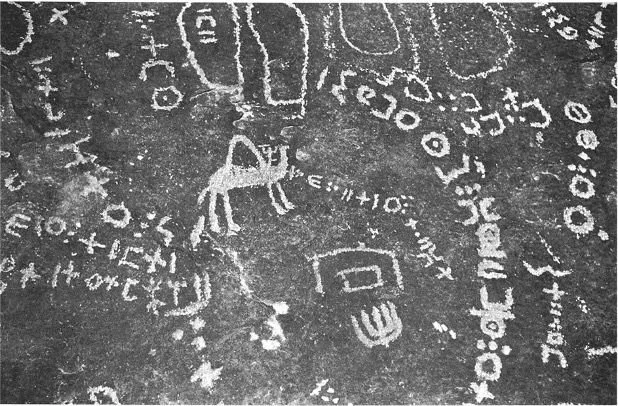
Fig. 1. Tizé n ighatimen, “pass of sandals,” Ahaggar (photo by H. Claudot-Hawad, 1974)
Amorphous and dynamic: the imagination of Tifinagh signs
The Tuareg vocabulary associated with Tifinagh is remarkably rich. In Tamajaght, the “signs” or “distinctive signs” are designated by the feminine term teshamunt, pl. tishuman. The “letters” are called tégamké, pl. tigamken, and the word is likewise feminine. The spontaneous etymology one of my interlocutors used to explain the meaning of tégamké to me is sociologically interesting—my aim here is not to consider or dispute its linguistic pertinence. It actually associates egam “to tap” and ehaki, “the sound,” which points back to the image of the “sound-tapper” that crystallizes the idea that every “letter” corresponds to a particular sound.
The writing is called errub (or ézmam) and the book with pages bound by a strap (ezemi) is called azemam. Like Hebrew and Arabic, Tifinagh is what is known as a “consonantal” script. Indeed, it has just one vowel, a, the pronunciation of which can vary. The a is drawn as a dot, presented as the origin of all forms. This one vowel frequently appears at the end of a word or sentence. In addition, there are two half-vowels, the ⵓ [w] and the ⵉ [y]. Yet each consonant in Tifinagh requires a vocalization for it to be sounded out in an intelligible way. With the exception of a, all the Tifinagh signs are learned and pronounced out loud in a vocalized form such as eba, eka, ewa, eha, era, egha, eya, etc, or yaba, yaka, yawa, yaha, etc. As Hamza Mohamed,[21] an Amahagh from Ahaggar, notes in a short video about Tifinagh, “We’ve got the vowels in our heads.” Influenced by Arabic, the pronunciation of consonants is sometimes abbreviated by removing the final vowel, which results in a closed syllabic pronunciation such as: eb, ek, ew, eh, er, etc.
In the Tuareg imagination, Tifinagh signs are endowed with distinct characteristics. Consonants are referred to as tiderfen, from the root drf, designating a kind of primary freedom or freedom of “nature.” Tiderfen communicates the idea of that which is original, stable, rooted, and unmoving. Derived from the same root, edaref / pl. iderfan refers to a social category of free or emancipated people who are bound to a community through a contract. In the realm of fauna, the term refers to an animal in a state of nature, or untamed, and in terms of the body, it refers to a child’s first teeth, or the baby teeth. Belonging to a semantic register with related connotations, the consonants are referred to as tidba (abstract plural in a), associated with that which is established and firmly rooted, such as tédebut, singular feminine, which designates the monumental Tuareg bed that is shaped like a chariot.[22] This bed, which is owned by women, embodies social stability—a foundation, a solid basis.[23] Another image refers to Tifinagh by describing it as tideban (feminine plural), associated semantically with édebun, “base, overhanging structure, promontory”—also used to refer to the state—or édebni, a pre-Islamic structure, reinforcing the assimilation of these signs to that which is stable, immutable, and original—i.e., that which anchors, founds, and shapes culture.
With the exception of a, the “vowels” are not written. Referred to as taraqémt / pl. tiraqam, they are semantically related to aragham, or “to orient, to guide, to lead,” and targhamt, or “education.” The term taraqémt suggests the idea of movement. In fact, the role attributed to vowels, which are indispensable to restoring the meaning of a text in Tifinagh, is to drive and orient the consonants. A somewhat pastoral metaphor offers the image of a flock of consonants guided by vowels that determine the direction of movement like a shepherd’s cries. The technique of reading Tifinagh by introducing vowels until the meaning of the word clicks is called talawayt (from alaway, a linear movement that can be used for anything that continuously progresses, such as a caravan, a melody, pain, a moan, etc.).
This way of understanding Tifinagh signs and their uses in language and writing, then, assigns weight to the consonants, which are viewed as static; meanwhile, they are set in motion by the light, flexible, and literally inconsistent (as they are not written) vowels. This combination of opposing and complementary elements—immobile and mobile—is what makes speech audible and writing comprehensible. This approach is consistent with a model of apprehending the real that is applied to a variety of fields. Woven into the Tuareg imagination are endless correspondences between antithetical pairs that define states, qualities, functions, and roles, such as stable/mobile, night/day, feminine/masculine, dark/light, etc. This principle of opposition is the catalyst of universal movement that animates and transforms everything in this nomadic philosophy of becoming.
Learning Tifinagh
The term tifinagh is in the feminine plural. In French, this word has been transformed into a masculine singular noun, “le tifinagh,” in accordance with the noun model used for languages and scripts (“le” français, “le” latin, “le” gothique,” etc.). The Tuareg relate the root ⴼⵏⵘ [fngh][24] to the idea of “to hide, to move away” in the sense of “to make secret.” For example, a child who has urgent business will be told, afnagh: “move away” from the road so as not to be visible. In keeping with the myth of the invention of Tifinagh by a marginal figure, Aniguran or Amamellen,[25]ifanaghen in the masculine plural designates things, signs, forms, and meanings that are set apart, reserved, and inexplicit; such a definition aligns with the idea that the meaning of the Tifinagh is not immediately accessible to all. Now we have completely entered into the non-alphabetic usages of this system of signs, to which I will return.
There are various techniques for learning Tifinagh. Some are based on mnemonic formulas pronouncing most of the Tifinagh letters, such as the version below, which is well-known in the Ahaggar region and presents twenty different signs. A close variant that includes “ult Ughnis” instead of “ult Awjiz” was identified by Foucauld in the twentieth century (1920) or Aghali Zakara (1994):
awa nak FaTimata ult Awjiz / aghebir-nit ur itwedis / tagalt-nit meraw iyesan d sedis
“It’s me, FaTimata, daughter of Awjiz / her hips are untouchable / her dowry is sixteen horses.”
Another learning method is for the system of signs called Tifinagh tin Aniguran, which doesn’t concern itself with local variations and is considered in the Ayer as “original” and ancient, linked to the Tuareg cosmovision that views the universe and all its components as in movement.
The initial formula taught to children produces all 26 Tifinagh signs in use. It has a riddle-like character and is learned like a nursery rhyme. The poet Hawad presents it as a secret formula in one of his poetry books,[26] with no explanation or translation:
Aghrem abjid hewaz ekhTey ikelman esghuf eDaD eqarcet etsha eZa edj ega
The oral vowels a, i, u, é, and a imuten are added to this statement to make it possible to read all of the consonant signs. Knowing that arghem, the first word of the Tifinagh memorization formula, is the name of the single vowel “a” and only represents this letter, the general sentence produces the following succession of Tifinagh signs:
ⴱ ⵌ ⴹ ⵂ ⵓ ⵣ ⵆ ⴸ ⵉ ⴾ ⵍ ⵎ ⵏ ⵙ ⵘ ⴼ ⴸ ⵗ ⵔ ⵛ ⴶ
Moreover, the method for teaching Tifinagh tin Aniguran refers to an architectural image, with the elements of the statement arranged into a pyramid (édebni) or a triangle (takarnakit) of four levels, with the single vowel located at the top or a fifth level by adding the vowels that are pronounced by elongating the sound to show all the possibilities of variation. Only the last vowel, which is called a imuten (the “dead a”) is said with a short sound.
Aghrem
abjid hewaz
ekhTey ikelman esghuf
eDaD eqarcet etsha eZa-edj-ega
a i u é a-imuten
“It’s based on these tools,” says Hawad,[27] “that the geometry (takarnaka) of our mind is constructed, even beyond words” Here, the author comments on the presence and movement of Tifinagh in his graphic art, which he calls zardazghanab, or “furigraphy.” This reflection shows a way of looking into uses for this system of signs, apart from the notation of language.
With this approach, learning Tifinagh appears as an important educational foundation for Tuareg children, preparing them to understand the world and for the psychological construction of self. This development of the “Amahagh self” is perceived as a journey (tagharasa) made up of a series of steps that Tifinagh could represent. An analogy is created between psychological states and Tifinagh forms that are endowed with a character or spirit (anezgum), i.e., a responsive property that has to be activated in order to face life, space, the environment—in other words, to participate in the universal journey that, according to the great dynamic principles of the Tuareg cosmovision, every being, everything, every element that comprises the universe must make.
Each stage represents a state before the movement for leaving this state is initiated and the next one reached. In this context, the symbolic weight of the signs and their interpretative value is to be found above all in their written forms and the relationships of filiation and transformation they maintain with other signs, with every sign appearing like a form in the making. Graphic kinship in Tifinagh is taught in the way of a poem, with the game being to learn how to notice this graphic logic, to absorb its underlying rules by assimilating them and reproducing them in a creative way.
It should be noted that the space in which all Tifinagh signs are inscribed is significant: a square traversed by four medians. This motif appears as a veritable distillation of the logic of distinguishing and assembling the elements that make up the architecture of the world in the Amahagh cosmovision. It is present in much of the decor. The structuring nature of the written forms reveals itself in all the ornamentations of the Amahagh—and, more broadly, the Amazigh—material environment. It defines an aesthetic that is also considered protective and capable of offering calm and reassurance, thus playing a psychological role.[28]
In terms of the mind, Tifinagh constitutes a graphical material that is involved extensively in tighunab, or esoteric knowledge. Aghanab refers to an art or a composition—graphic, gestural, auditory—called upon to express a situation, to understand it, to contain it, and to act on it or even act on oneself in order to confront it. It is in this way that Tifinagh signs have served to create formulas for protection and cosmic re-grounding. These writings, which artisans insert into leather or metal cases, are called tirawt / pl. tira. They’re worn against the body, hanging from the neck or attached to the arms with leather cords. Currently, the spells used for these “amulets” are primarily drawn from Islam and written in Arabic. Moreover, the Tuareg system of divination (igezan) widely uses Tifinagh forms in its translation of “chance,” which is rendered as dots and lines, with the combination resulting from the addition or subtraction producing condensed spells where each sign (some of which are Tifinagh) bears its own name that corresponds to everything it symbolizes in this context.
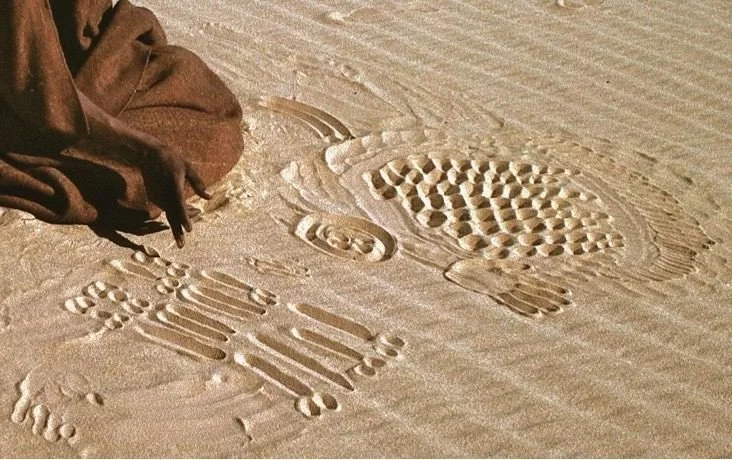
Fig. 2. Igezan, geomancy (photo H. Claudot-Hawad)
Kinship Relations Within Tifinagh
There are four different Tifinagh families: Ti n titabaqa, “the ones (Tifinagh) with dots”; Ti n tirkab, “the ones with lines;” Ti n izaranzaran, “the ones with zigzags;” andTi n tiglela, “the ones with circles.” This classification resonates with a cognitive model that is taught to think about elements in a state of becoming. The language makes it possible to conceptualize successive degrees of a state (from its tangible appearance to its completion), such as in the nuanced vocabulary to designate the “void”– iba, énmabat, énabat, ebat —or “vision-conscience”—egi, enuga, egana, ég.
In terms of graphics, these subdivisions correspond to four operations: the dot (tatebaqét) that anchors or roots; the dash (tarakebt) that creates connections (tasaghin); the zigzag (ézranzari) that makes it possible to avoid obstacles and that creates exchanges; the circle (egleli) that encompasses (esegeli) by providing a stable form, which refers to a complete cycle and what is enclosed.
The first of the first family (titabaqa) isthe dot that represents a. It’s the first letter. To communicate the importance of this sign, Hamza Mohamed, of the Ahaggar, employed numerous adjectives: “so philosophical, so ingenious, there’s a message.”[29] He said that the a “is the beginning of the world, it’s the atom, it’s extraordinary... All other forms of writing started with a.” Hawad, of the Ayer, thought along the same lines: “The beginning of everything is the dot. The dot is the anchor, the root, the beginning.”He added, “The dots combine with each other to give birth to forms that represent ways of depicting and ways of being that are destined to change.”[30]
Everyone rather freely establishes their own mental framework for memorizing signs in relation to the environment. Several instructional approaches include the notion of a step-by-step or bit-by-bit progression, with the elements that make up the Tifinagh being introduced along with the processes of subtraction and addition that make it possible to gradually compose the signs. This is the case, for example, in the educational game called eshighen, where players push pieces toward the top of a triangle drawn on the ground until four elements are obtained, either through capturing or subtracting, and then unloaded onto the opponent.
In an interview about his education and learning Tifinagh as a child, Hawad mentioned the visual descriptions applied to connect the written forms. What follows in the paragraphs below owe a great deal to this exchange.
Doubling the dot in the first sign results in the ⵓ (ewa). Adding a dot or a “step” to it in the modification process, which is likened to walking, can produce the ⵗ (eqa), but also, in an arrangement that is considered more stable, the ⴾ (eka), compared to three stones of the hearth, with the three dots approximating the important, recurring geometric shape of the triangle, which in this imaginary corresponds to the “half of another body or another step.” Here, the “body” (taghasa) evoked refers to an image that is extremely present in all ornamentation: the double triangle ⴵ (outside observers use the term “hourglass” to designate its shape), which interlocks with another horizontal double triangle in the all-encompassing design of the square traversed by medians.
Another example, the double ⵓ (ewa) can produce the four dots of the ⵂ (eha)—associated with iha, “it is inside”—suggestive, as per the formula that is taught, of “the loading of merchandise that the caravan drivers line up on stones when the ground is wet or so as to avoid insects.” By arranging the dots not in a line but so they are rather superimposed, two ewa result in ⵆ (ekha), a form that is called ekuzet (the “four”) and that symbolizes a stable construction, a shelter, a place where travelers can settle in. The new step represented by ⵘ (egha) refers to a shelter that this time is inhabited, embodying that which protects or that which is protected. With the dot in the center, araynat, the merging of waters or roads, appears. This sign is evocative of foundations. It’s a position of stability and centrality that is the starting point for all roads and directions to come in charting the routes of the future and building new foundations.
Some signs are related to the next family. Such is the case for ⴶ (ega), viewed as “the three dots of ⴾ (eka), with one pulled out to recall ⵓ (ewa).”
This brings us to the second family of the Tifinagh, ti n tirkab, “the one of lines,” whose arrangement evokes walking and connections—i.e., the movement from one angle to another, from one dot to another, or from one stage to another. Children are given relatively visual formulas to help them remember the signs by connecting them to other elements, always returning to the dynamic principle at work in the form of the signs to recall the stage from which they come. For example:
“The three dots of ⴾ (eka) formed the three lines of ⵎ (ema) ; ⵍ (ela), it’s the three lines of ⵎ (ema) with one missing; ⵏ (ena), is one line that left the two lines of ⵍ (ela); ⴸ (eDa) is the two lines of ⵍ (ela) that form the fork (efalghash) ; ⴹ (eda) is the three lines of ⵎ (ema) neighboring (animaragnin),” meaning “that camp alongside each other.”
The third stage is the family of tin n izaranzaran, that of zigzags or twists and turns—i.e., lines that meander to avoid obstacles, meaning these signs are curved or bent, with forms that describe movement. This suggests the difficulties of walking between stages and reveals how the sign itself, with its contortions and ways of bending and rippling, creates a particular form that is simultaneously a shelter and a way of being and communicating with the unknown. This family includes in particular: ⵉ (eya), ⵣ (eza), (eZa), ⵌ (eja), ⴼ (efa), whose family relations are represented in the learning of Tifinagh. For example, ⵌ (eja) is seen as a double ⵣ (enétfer n eza) without feet, the graphic kinship between the two signs allowing us to make a connection with the permutation in Ahaggar of the forms of eza and eja from the Ayer. The (eZa) is considered to be half of the ⵣ (eza) because:
“the form of the eza is two triangles that meet, as with the eZa, except that the two triangles of eza are each cut in the middle into two other triangles. For us, this means something, it’s a double hearth. Every being has an origin that is a hearth, aghiwen. When there’s a bar passing through the middle of the triangles, this signifies that there is a meeting of two double entities. As such, there is a total of four entities in the eza... in other words, two initiates who bear within themselves their invisible double, their esuf, and who meet, confront each other, and become allies. ”[31]
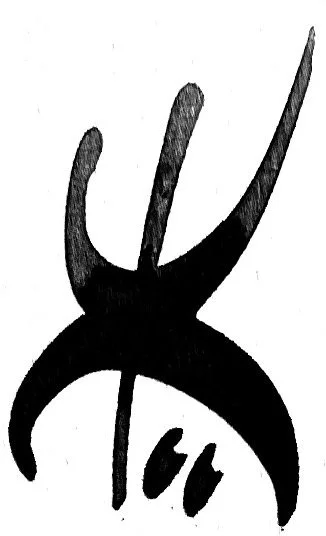
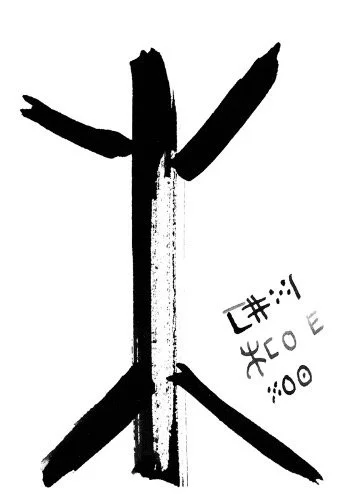
Fig. 3a and 3b. Two forms of Eza (inks by Hawad, 1985, p. 17 and 1990, p. 8)
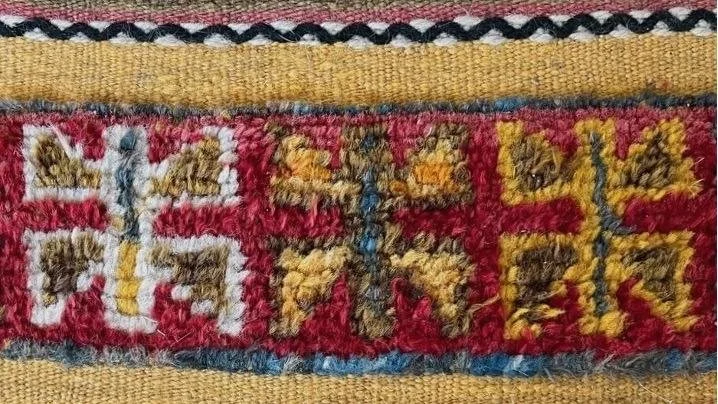
Fig. 4. Woven Eza (Ouazazate rug)
The ⵛ or ⵛ (esha) is associated with that which is hot (ikusen), enraged, and nervous, and with everything that crackles. The very form of the esha is interpreted as a precarious assemblage, with two poorly arranged triangles (or two hearths) that form a figure lacking in harmony and contrast, for example, with the stable shape represented by the square and the circle (a model of balance combining four hearths). It embodies dissociation, disunity, and negative energy. The esha sign appears in some alchemical texts, and in North African Cabalism is known as the “glasses” with a repulsive force that protects from the “evil eye.” It is also connected to a sign from the next family, the ⵙ or ⵙ (esa), which it embodies in its “enraged” form (esawanshi), communicating a state of instability and unease that needs to be curbed.
The last stage is the tiglela family, presented as the refinement of forms, capable of surrounding or encircling—egleli means “circle”—in the sense of “grasping something, grasping a situation,” of giving it a shape or a face (udem).[32] These signs have a geometric shape that can be round or square, depending on the style chosen: ⵔ (era), ⵙ (esa), ⴱ (eba), connected in the following formula quoted by Hawad, which refers to a second level of interpretation that will not be explored here:
Era esa tegmad tatbaqét n tabutut-nét ta tutesaghat antén tarakébt ta teshalwet emas n eba “ⵔ (era) is the ⵙ (esa) that extracted the dot from its navel, which connects it to the line that enlarges the interior of the ⴱ (eba)”.
As the examples provided here show, Tuareg Tifinagh instruction focuses on the perception of signs in their interrelationships. If learning Tifinagh is considered to be an educational foundation that opens children’s minds, this is because it teaches them a genuine method of observation and comprehension that applies to various levels of reality.[33] This pedagogical approach offers conceptual tools for grasping facts not as disparate and isolated elements but as parts of a system that is being constantly reconfigured by the relational dynamics of its components. The conception of the changing written forms recalls an essential principle at work within the Amahagh imagination: the idea that everything is metamorphosis. As such, every sign isn’t just a letter that corresponds to a sound and an alphabetical value, but refers to other levels of comprehension, such as the attitude or the way of being depending on the given stage for the journey of each being, each element, and each thing.
The character attributed to Tifinagh signs allows for various types of code exchanges, such as secret language that can be used discreetly to communicate with a peer about a situation or psychological environment. The process consists of drawing signs, either on the ground or in the air, to describe the behavior of certain key players and to anticipate the responses to be given based on the desired outcome. The same is true for the language of love, with messages in Tifinagh drawn with a finger secretly on the partner’s hand or arm.
Tifinagh and neo-Tifinagh: Possibilities for exchanges?
The capricious forms of neo-Tifinagh created a real break with Tifinagh, which is rooted in a living civilization more than thousands of years old. It broke the subtle and intimate ties that this system of signs maintains—for its contemporary users, the Amahagh·s—with their particular aesthetic, with the ritualistic motifs painted on their bodies at various ceremonies, with the rock inscriptions that map out their territory, with their perception of space, with their psychology, with their vision of how the world moves, with their cosmovision.
How to recreate a place of exchange between Tifinagh and neo-Tifinagh to foster mutual enrichment, which would involve the dense, complex knowledge borne by the Tuareg Tifinagh, on the one hand, and the technical sophistication that has allowed for the digital usage and distribution of neo-Tifinagh for recording the language, on the other? How to keep the globalized typography of neo-Tifinagh from destroying the written forms used by the Amazigh·s of the desert, whose writing has, without state, schooling, or official support, been able to resist being dominated by hegemonic cultures for more than 1500 years?
Along with the neo-Tifinagh prioritized by the Unicode system, it would be both ethical and advantageous to introduce these Tifinagh characters with their meaningful forms on a trans-Amazigh scale. This would make it possible to not exclude the Amahagh·s and their valuable knowledge from globalized digital communication and it would also open up innovative lines of research, finally free of any evolutionism, into the deep structuring logics at work in Amazigh geometric aesthetics.
As I have attempted to demonstrate, Tifinagh is a projection and dramatization of the interactions between humans and nature, between the visible and invisible, and between the known and the unknown. In their written forms, these signs have a cosmological significance. That is why they can be connected to the prevailing geometric ornamentation in, for example the festive make-up of young girl from the Ayer (fig. 5), where all the stages described for the signs in movement can be seen: dots, lines, zigzags, and the linear combination of four triangles drawn in pairs, vertically and horizontally, and forming a double eza. This combination remains open to subsequent transformations catalyzed by encounters with alterity. As such, the three lines that start from each triangle or the dot-stages of the path suggest routes leading to the unknown (esuf) that are taken in order to create new alliances (see “Cosmogonie touareg,” Encyclopédie berbère XIV, 1994).
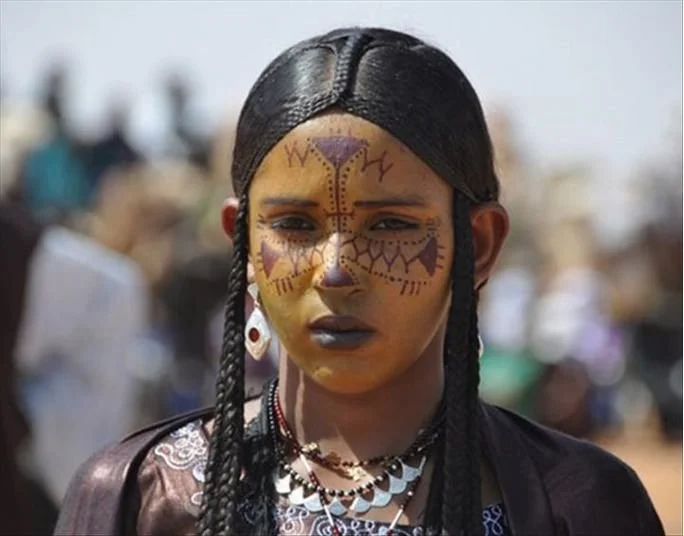
Fig. 5. Festive make-up worn by a young girl from the Ayer (© Autre presse par DR)
This is the virtual union of the four triangles which in this arrangement create a stable form obtained at the end of the winding journey of various elements. The motif of the double eza is found on the Tuareg shield made of oryx skin (fig. 6). This graphic figure has an all-encompassing character. It depicts the universe in movement and the manifold elements comprising it, projecting through dots, lines, and zigzags their final alliance, which alone is capable of constructing society, the world, and the cosmos. In this system, the stable forms themselves retain the dynamism that will allow them to begin other cycles of transformations induced by each encounter with alterity, a process that is highlighted, for example, by the systematic way that rock inscriptions are crisscrossed.
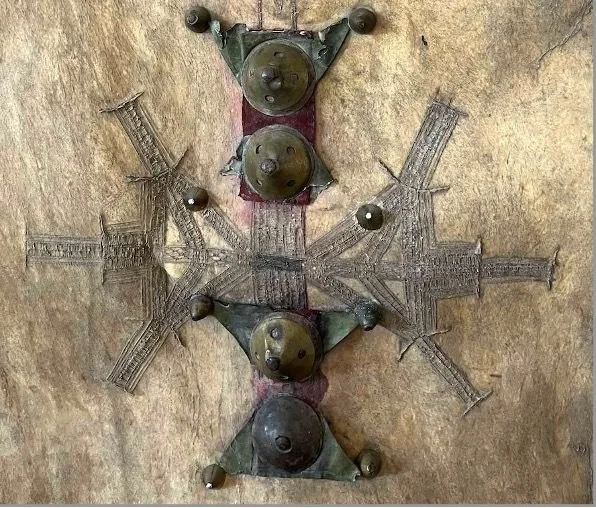
Fig. 6. The double eza motif on a Tuareg shield (Ahaggar, oryx-skin shield, early 20th century)
Linking the written forms of Tifinagh to the cosmocentric logic of the ornamental motifs of the Tuareg (and, more broadly, Amazigh) aesthetic, these interpretations resituate Tifinagh and its interactive written forms, organized into families of signs, into a signifying semiology. These practices make it possible to better grasp the loss of meaning resulting from the alphabetical normalization of Tifinagh as well as the “de-Berberization” or “de-Amazighization” caused by the creation of neo-Tifinagh, which Amahagh·s view as “mangled” Tifinagh. A first step toward emerging from this cognitive impasse created by a neo-Tifinagh with no meaningful roots would be to focus on the ancestral or mental experiences that Amahagh·s of the desert have had.
Contrary to the widespread conception that “because Tifinagh has not been used to record literature, history, or law, it ultimately did not communicate knowledge,”[34] I would advance the opposite hypothesis. In the logic of their written forms, the Tifinagh signs and their system of intelligibility are the preferred medium for the Amazigh cosmovision, and they implicitly communicate the vast knowledge that connects the Amazigh societies to their human and non-human environment, to life, and to the universe. It is precisely for this reason that it has been possible for this system of signs—along with all the philosophical, spiritual, and sacred knowledge which is serves as a privileged medium for—to be transmitted in its current form, though rooted in even more ancient prehistoric origins, from generation to generation for more than a millennium and a half. Ultimately, transforming Tifinagh into a simple alphabet –that can be redesigned at will according to the individual or collective whims of those who are disconnected from the multifaceted uses of this system of signs– is tantamount to amputating the Amazigh civilization from its original and complex way of thinking about the world “differently”.
Bibliography
Aghali-Zakara, Mohamed. “A propos de la notation du touareg.” Bulletin des Études Africaines de l’INALCO no. 1 (1981):9-23.
Aghali-Zakara Mohamed. “Graphies berbères et dilemme de diffusion. Interaction des alphabets latins, ajami et tifinagh.” Études et Documents Berbères, no. 11 (1994):107-121.
Boumalk, Abdellah and Ameur, Meftaha, eds. Standardisation de l’amazighe. Actes du séminaire organisé par le Centre de l’Aménagement Linguistique à Rabat, December 8-9, Institut Royal de la Culture Amazighe, 2004.
Bouhjar, Aicha. “Le système graphique Tifinaghe-Ircam.” M. Ameur and A. Boulmak, eds. Standardisation de l’amazighe, IRCAM (2004): 44-62.
Camps, Gabriel. “Écritures libyques,” Encyclopédie berbère XVII, 1996.
Chafik, Mohamed. “Initiation au tifinagh.” Tifinagh, no. 1 (1993/1994):5-10.
Chaker, Salem. Textes en linguistique berbère. (Introduction au domaine berbère), CNRS, 1984.
Chaker, Salem. “Pour une notation usuelle à base ‘tifinagh,’” Études et Documents Berbères, no. 11 (1994):31-42.
Chaker, Salem. “A propos de l’origine et de l’âge et de l’écriture libyco-berbère.” Etudes berbères chamito-sémitiques. Louvain, 2000.
Chaker, Salem. L’écriture libyco-berbère. État des lieux et perspectives. Centre de Recherche Berbère, Inalco, 2011.
Chaker Salem. “L’officialisation de Tamazight (Maroc/Algérie) : quelques réflexions et interrogations sur une dynamique aux incidences potentielles considérables.” Asinag, no. 8 (2013): 39-50.
Chaker Salem. Diachronie berbère, Linguistique historique et libyque, Presses Universitaires de Provence, 2024.
Claudot-Hawad, Hélène. Tifinagh, Du burin à la plume, Atelier du triangle, Dauphin, réédité en 1993. Touaregs. Portrait en fragments. Edisud, 1985.
Claudot-Hawad, Hélène. “Amamellen,” Encyclopédie Berbère (4)/A178, 1986.
Claudot-Hawad, Hélène. “La conquête du vide ou la nécessité d’être nomade chez les Touaregs.” Revue de l’Occident Musulman et de la Méditerranée, no. 41-42 (1986): 397-412.
Claudot-Hawad, Hélène. “Tifinagh. De la plume à l’imprimante.” Travaux du LAPMO, CNRS, 1988.
Claudot-Hawad, Hélène. “Écriture tifinagh.” Encyclopédie berbère XVII, 1996.
Claudot-Hawad, Hélène. “Les Tifinagh comme écriture du détournement. Usages touaregs du XXIe siècle.” Études et documents berbères, no. 23 (2005):5-30.
Claudot-Hawad, Hélène. “Hors académie, hors Etat, hors media: l'écriture vivante des Touaregs.” Roque M-A. Les Amazighs aujourd'hui. La culture berbère, Publisud/IE Med, 2010, 95-102 ⟨halshs-00723625⟩
Claudot-Hawad, Hélène. “Avoir de la cendre. Ancrages nomades en territoire touareg.” Techniques & Culture, no. 56 (2011): 78-97.
Coninck, J. (de) and Galand, Lionel. “Un essai des Kel Antessar pour améliorer l’écriture touarègue.” Compte-rendus du GLECS VIII (1960):78-83.
El Maadani, Selma. Interview with Y. Montenay. “Le nouveau tifinagh. Un alphabet disparu sauvera-t-il les langues et cultures berbères?” Synergies Monde Méditerranéen, no. 4 (2014):25-38.
Encyclopédie Berbère, https://journals.openedition.org/encyclopedieberbere/
Ferkal, Masin, and Chaker, Salem. “Néo-tifinagh.” Encyclopédie berbère, forthcoming.
Figueiredo, Cristina. “Le roc et le corps. Lieux d’objectivation de l’esprit chez les Touaregs (Mali).” F. Héritier-Augé and M. Xanthakou, eds. Corps et affects, ed. Odile Jacob, 2004: 105-120.
Haralambous, Yannis. “Unicode et typographie: un amour impossible.” Revue des sciences et technologies de l’information. Série Document numérique, 6 (3-4), (2002): 105-137. https://hal.science/hal-02111996
Hawad. Caravane de la soif. Aix-en-Provence: Edisud, 1985.
Hawad. “La teshumara, antidote de l’Etat.” Revue du Monde Musulman et de la Méditerranée, no. 56 (1990): Aix-en-Provence: Edisud.
Hawad. Buveurs de braises. Edition bilingue touareg noté en tifinagh/français, MEET, 1995.
Hawad. “Inventer nous-mêmes notre futur.” H. Claudot-Hawad and Hawad, eds. Touaregs, Voix solitaires sous l’horizon confisqué, Ethnies (Survival International), 1996.
Hawad. “L’élite que nous avons voulu raccommoder sur les cendres... après la création des Etats africains.” Nomadic Peoples no. 1-2, 1998.
Hawad. Sahara: Visions atomiques. Paris: Paris-Méditerranée, 2003.
Hawad, “Une éducation nomade.” Interview by Hélène Claudot-Hawad, January 2024.
Hincker, Catherine. Le style touareg ou la fonction sociale des techniques, Paris/Aix-en-Provence: Paris-Méditerranée/IREMAM, 2005.
Lguensat, Mohammed. Aménagement graphique de tifinagh. Les questionnements relatifs à l’adaptation cursive et à l’optimalisation visuelle de la graphie amazighe. Incluant des propositions cursives, cursives stylisées et semi-cursives pour le système tifinagh. Rabat: IRCAM, 2011.
Louali, Naïma. “Voyelles touarègues et systèmes de transcription.” Etudes et Documents Berbères no. 11 (1994):211-216.
Mohamed, Hamza. “Tifinagh: le Symbole Visuel d’un Rêve,” video, in The Atlas of Disappearing Worlds, 2024.
Mounin, Georges. Clefs pour la langue française. Paris: Seghers, 1975.
Prasse, Karl-G. “Ecriture,” Manuel de grammaire touarègue, vol. 1, Akademisk Forlag, chap. 2 (1972):145-161.
Rinn, Louis. “Lettres de Touareg.” Revue Africaine, no. 185 (1887):321-338.
Zenkouar, Lahbib. “L’écriture amazighe Tifinaghe et Unicode.” Études et Documents Berbères, no. 22 (2004):175-173.
Footnotes
[1] Paper for the Tribute to Professor Salem Chaker: “A Legacy of Words and Knowledge” National Library of the Kingdom of Morocco, Rabat, February 18-19, 2025.
[2] The masculine singular of one of the pronunciations of this term (Amahagh) will be used here, based on the noun “Amazigh” used in French today with the French syntactical markers for gender and number added. Alternatively, the exogenous term “Tuareg” will be used in an invariable form.
[3] Salem Chaker. Diachronie berbère, Linguistique historique et libyque (Aix-en-Provence: Presses Universitaires de Provence, 2024), 191.
[4] The prehistorian Gabriel Camps (1996) bases this datation on the engraved Tifinagh slabs that were used to construct the funerary monument for Tin Hinan, the legendary ancestor of the Tuareg of Ahaggar. The grave goods of this tomb, located in Abalessa (Ahaggar), are dated to the 5th century, C.E.
[5] There is an interesting trace of correspondence in Tifinagh at the end of the 19th century in the article by Louis Rinn that presents eleven letters written by seven Tuareg prisoners (Taytoq from the Ahaggar) detained in Algiers in 1888 by the French colonial authorities. In one of these missives, the words are separated, which facilitates the reading of the text.
[6] Chaker, Diachronie, 191.
[7] https://centrederechercheberbere.fr/touareg.html
[8] In addition, there is the confusion between Tamahaght, spoken by the Amahagh·s of the Ahaggar and the Ajjer, and Tahaggart (the only one mentioned on this map), a term that refers to a “noble woman” and literally the “noble language.”
[9] George Mounin. Clefs pour la Langue française (Paris: Seghers, 1975), 147-170.
[10] Chaker, Diachronie, 192.
[11] On the emergence of various neo-Tifinagh models within the non-profit context, see Ferkal and Chaker 2025.
[12] On the consequences of the state’s formalization of the language, see the critical analysis by S. Chaker (2013).
[13]Aicha Bouhjar, “Le système graphique Tifinaghe-Ircam” in eds., Ameur and Boulmak, Standardisation de l’amazighe (Rabat : IRCAM, 2004), 51.
[14] See, Chafik, 1993/1994.
[15] Chaker, Diachronie, 194.
[16] See, for example, Coninck and Galand, 1960; Claudot-Hawad, 1985, 1989; Louali, 1994.
[17] On this topic, see Hawad 1990, 1996, and 1998.
[18] The digitization of this system of notation made it possible to publish the Tuareg journal “Le chameau bègue” (https://www.editions-amara.info/le-journal-touareg-en-tifinagh/) in the 1990s, along with the bilingual version of a work by Hawad (1995, Buveurs de braises), as well as other poetic texts.
[19] See, Ameur and Boumalk (eds.) 2003; Lguensat 2011; Zenkouar 2004.
[20] Regarding this type of problem created by the dominance of “preferred glyphs,” see Haralambous 2002.
[21]Hamza Mohamed, “Tifinagh: le Symbole Visuel d’un Rêve,” video, in The Atlas of Disappearing Worlds, 2024.
[22] Ibid.
[23] On this topic, see H. Claudot-Hawad, 2011, pp. 78-97.
[24] On the origin of this term, see the numerous historical and linguistic hypotheses revisited and analyzed by Chaker in several of his publications, including his recent work.
[25] Hélène Claudot-Hawad, “Les Tifinagh comme écriture du détournement. Usages touaregs du XXIe siècle.” Études et documents berbères, no. 23 (2005):5-30.
[26] Hawad. Sahara, Visions atomiques (Paris: Paris-Méditerranée, 2003), 65.
[27] Hawad, “Une éducation nomade.” Interview by Hélène Claudot-Hawad, January 2024.
[28] I was struck by a young Tuareg woman’s thoughts about jewelry that artisans created for tourists who themselves made drawings to go along with their requests—large pendants that she referred to as “jewelry for horses,” with ornamentation and shapes that she viewed as ridiculous and harmful: “I wouldn’t wear that. That’s something that makes you crazy.”
[29] Mohamed 2024.
[30] Ibid.
[31] Hawad 2024.
[32] Here, it’s worth noting the particular function that esa has in the Tuareg geomancy (igezan): once the sand is cleared of its impurities, patted and smoothed to “plunge” into the world of intuitions, the first sign drawn before the exercise is begun is the esa, which represents the “eye” that will identify the situation.
[33] Also see Figueiredo 2004 and Hincker 2005 regarding the intersection of modes of cognitive acquisition in children.
[34] Yves Montenay in Selma El Maadani, “Le nouveau tifinagh. Un alphabet disparu sauvera-t-il les langues et cultures berbères?” Synergies Monde Méditerranéen, no. 4 (2014):25-38
DOWNLOAD
ISSUE
Volume 5 • Issue 1 • Summer 2026
Pages 5-24
Language: English
INSTITUTION
CNRS (Anthropologist, Honorary Research Director)