
Art Research and Tamazgha Futurity
Amazigh Matrimoine from Fragments to Future
Interview with Raïssa Leï
AUTHOR: Katarzyna Pieprzak
Amazigh Matrimoine from Fragments to Futures
Interview with Raïssa Leï
Katarzyna Pieprzak
Raïssa Leï has many different professional identities: cultural entrepreneur, choreographer, dancer, and “artivist.” She is also proudly Amazigh in France.
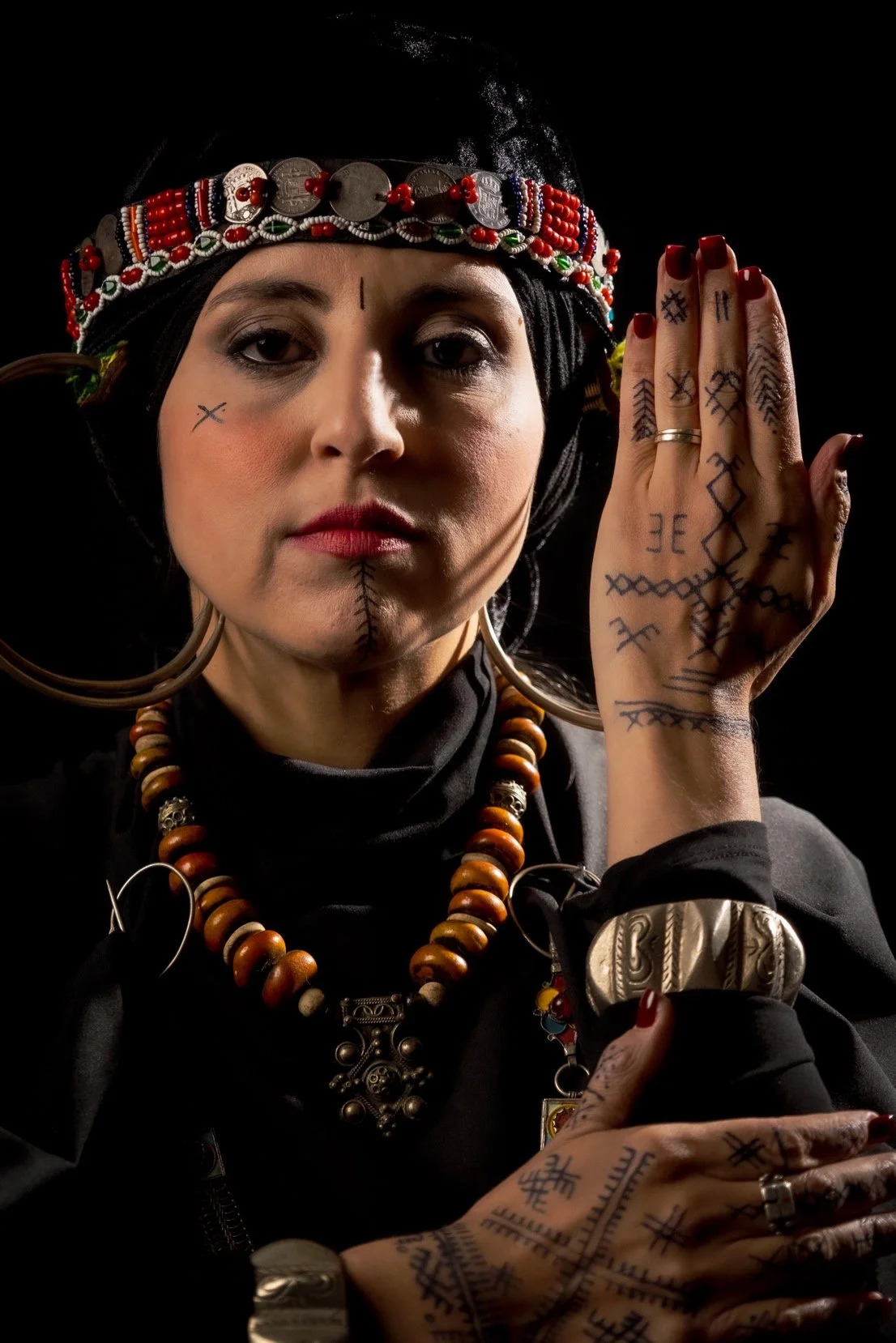
My introduction to her multifaceted work was in 2024 through her then newly-launched website: Timazighin.com. The website showcases her pluridisciplinary work on women and the transmission of Amazigh culture in France. As she states on the landing page: “Through memory, art and creativity - workshops, dressing sessions and events - I invite you to pass on, rethink, celebrate and reappropriate for ourselves our Amazigh culture.” Raïssa describes the mission of her work in the following way: “Since childhood I have been fascinated by Amazigh dance, music, jewelry, tattoos and clothing. But all this “matrimoine” which is transmitted above all through oral practice, came to me in a fragmented way. Through research, I discovered colonial texts about my own tribe and orientalist photographs and paintings of Amazigh women, images that are simultaneously roots and wounds and that have pushed me to question heritage and its transmission. Today, as a mother, the question is even more urgent: how do we overcome absence or the loss of transmission? How do we resuscitate practices that have disappeared, or invent new ones which speak to future generations?”
Raïssa’s research takes on particular importance in its embodied aspects. Rather than staying primarily in an academic realm, her research is actualized through transmission and embodied participation in the construction of knowledge. One example are the dressing sessions that she holds in which Amazigh women from the French diaspora dress and are photographed in the clothes and jewelry of their indigenous communities from Tamazgha. In one 2024 video of such a session, Raïssa documents the emotions of an older woman wearing the material traces of an indigenous culture from Aurès that has been marginalized in both Algeria and France. Dressed in jewelry that she no longer has access to, we see her smile, then ululate and then dance with pride and joy. The clothes and jewelry appear to unlock deeply held corporal memories - movement and bodily positions - that restore broken transmission due to migration, colonial dispossession, and/or generational silence. This is precisely the reappropriation of Amazigh material culture that Raïssa works to bring forth today through Timazighin and through other projects, past and future as a choreographer, dancer and “artivist.”
Since that initial virtual encounter, Raïssa and I have had long conversations about her work both in Paris and Williamstown, MA and over Zoom and WhatsApp. This interview was conducted in French in February 2025 via Zoom and has been translated into English and edited for length and clarity.
Katarzyna Pieprzak (KP): How did you come to do this type of multidisciplinary work: the work of an artist, choreographer and activist?
Raïssa Leï (RL): I think the turning point was when I first discovered colonial writing about my tribe and as a result, I realized that I was missing many cultural materials. I'm lucky enough to know exactly which tribe I come from, from eastern Morocco, a small Amazigh tribe. Many people think I'm Riffian, but I'm not Riffian. I come from a small Zenete tribe, and there are a lot of fantasies and hogra [discrimination, humiliation and contempt] about and for my tribe, and it took me a while to understand why. In fact, I realized that it's because my tribe was too Amazigh. It was too Amazigh because for a long time we kept our language, we kept our ancient rituals, we hated the Arabs. Until my grandmother's generation, we kept all the traditions. Until my parents' generation, there were almost no people who weren't married within the same tribe. We passed on the tattoos, also the way of speaking, of acting. Well, as soon as that generation went to the city, they faced local discrimination, with people saying that we were savages and backward. Even when I go back to Morocco today, when I say which tribe I come from, people don’t believe me. They say "Oh, it's because you come from France," as if to say, "You're too educated to be part of those people." So I have felt a lot of denigration.
We are a community that is very, very poor and so that is a primary factor in the tribe’s representation both in Morocco and in France. There was a lot of colonial writing in France, and it was used as a tool of colonial propaganda and a military tool, like what happened to my tribe. For example, the objective of the colonial writing about my tribe that I found at Columbia University was to prove that we preferred to ally ourselves with the French cause than with Muslim Arabs, and that we were more for French colonization than for a monarchy. Colonial writing was the first trigger for my work.
The second trigger was becoming a mother, and asking what I could pass on to my daughters. I have devoted my whole life to make Amazighity visible through all the avenues I can use. When I say "avenue," obviously, at first glance, it could be art or culture, but it can also include my previous professional roles in the corporate world or as a career coach. I'm going to say that this Amazigh identity, this strength, has been something I've used as a pillar to succeed in my professional life and as a source for empowerment. And that's what I call a “matrimoine” approach, a practice that, I think, is quite new, since it's geared towards renewal, repair, and a lot of innovation.
KP: How do you see your work as a form of “matrimoine” and what does the term mean?
RL: I became a mother right during the lockdown period, and suddenly, I found myself very alone because my husband had to go in to work, and I found myself all alone with my baby. There are people who have experienced worse isolation, but for me and first-time mothers in general, we needed that shared experience and knowledge that comes from living with their family during the first 40 days after childbirth. It felt like a big slap in the face to be alone, and I said to myself: “I still want to give a lot to my child. What can women from my tribe, of my lineage transmit? And more generally, what can Amazigh women give? Not what have they given in the past, but what can they give today? What heritage do women pass on?”
I'm in my apartment with my daughter who is also 100% Amazigh, because the father is too, but it's the same question that arises in our countries of origin for all the people who have abandoned ancestral traditions or who don't have a choice but to abandon them. In our origin countries, the material resources are now all there: there is water, there is electricity, there are telephones. But inevitably, there are lines of ancestral transmission that break. Certain ancestral practices are disappearing. So what do we keep, what do we save? And if we make the effort, in fact, to resurrect just some practices, what in turn do we abandon?
And so that's where the word matrimoine—I don't even know how to describe it in English—came to me, and I said to myself: Here I am again facing these “invisible” subjects, and here is a word that is so simple and can define everything I want to materialize. When I was preparing my TedX talk, I wanted to use matrimoine, and I realized that there was no actual translation in English for matrimoine: it's not matriarchy, it's not matrimonial. All these semantics made me wonder, and made people ask me, if what I was doing was actually about inheritance and heritage. And what can heritage mean when transmitting wealth that is truly, uniquely feminine, something that a woman is capable of producing?
Here, I take this word matrimoine, and it's more than just semantics of inheritance. It's actually conveying what inheritance means for Amazigh women, when it might consist of a box containing jewelry that you inherited from your mother, from your grandmother, or if you weren't lucky enough to inherit, that you bought yourself. Well, for me, it's all part of matrimoine, since it's something I'm going to pass on to my daughters. So, you know this word is actually quite powerful and it's the foundation of all my work.
It's also the basis of all my work because I lived only with women growing up, almost all of whom were widows. I lost my father at the age of eight, and so I took everything I had to learn from women, because we were also not invited into male spaces.
KP: The thing that strikes me in your use of the concept matrimoine, as I see it in your work, is that it isn’t just defining a female cultural practice of transmission, but that it's actually broadening the conceptualization of inheritance to include all forms of gendered transmission. In other words, in matrimoine inheritance is reframed as the broader idea of knowing how we produce and how we transmit. The term centers the life of women and female practices, but it's broadly inclusive of all transmission.
RL: That's exactly it. The idea behind the matrimoine I advocate is to give women their power back and an awareness of the role they play in transmitting knowledge. Our generation, especially those who were uprooted, people from the diaspora, must raise awareness of this role in transmission. We can say: Okay, it's my turn now, and what can I do? And sometimes we're both learning and passing things on, we're learning while we pass them on to our children because we didn't have certain knowledge. We might ask questions and say to each other: "Okay, we have to do it this way," or "Actually, I thought it was another way," or "I don't know at all." So we'll go and discover things together, we'll go to our ancestral lands together, we'll go and make things together. Anyway, there is much to discover together and what's powerful is that ultimately you make up for all that time, time which wasn't lost, it's just that it's not linear. In fact, when we think of the process of learning and passing on, every year we give a little time, a little more, a little more. It really can also be nothing for a long time and then boom, suddenly we have an awareness of what we are transmitting, and that's very often what happens when I talk with women who are in the same process as me.
KP: So that raises two questions that you mentioned earlier: what do we keep, what do we let go? And what are Amazigh concepts or practices that are very present for you in your work today?
RL: For me, it's true that movement, actually dance, is essential for me because it was my first tool for identity work, and for me it brings together a lot of important concepts of Amazighity. Dance reconnects us to the tribe, because the dances I teach or perform are collective dances. They reactivate the social purpose of dance and therefore the social purpose of the tribe and the village, since generally, when we dance, it's to celebrate something, it could be a birth, a wedding, a betrothal…. In this type of social context, there will also be clothing that will vary depending on the village, jewelry, makeup for the women, the way we dress the children, the meals we prepare, and finally, the symbolism of the dances themselves, their links to nature, as well as to our colonial migration history. Dance, as well as the lyrics, music and language that accompany it, tells a tremendous number of stories. So when I say dance, that is the heart of my fight for transmission.
In France, people will say: Yeah, your dances are belly dances, camel dances. I've been told that before. But I have a vision of my ancestors performing war dances in the mountains. Well, that's what I see right away when someone says dance to me. My shoulders start twitching, and suddenly it activates me, my body and the knowledge it holds. There are many people who come to me asking: "Hey, I don't know how to dance at all," And I say, "Well, I'm going to activate you, Boom, like a button. It will take two sessions, three or ten, and systematically, it happens. People are reactivated; they are reactivated. That knowledge is in their DNA, in the blood that flows through their veins from their ancestors.
That reactivation occurs in the same way when I put jewelry on women. It's impressive to witness. I just draw on the small tattoos, and we'll automatically stretch back in time, and that's it, it's normal. We have the same faces; we have the same way of behaving and carrying ourselves.
The activation that dance or jewelry generates in my work, is always ultimately in relationship to the body. For me, that's essential, if we manage to keep that relationship between knowledge and body through dance then there are at least ten other types and combinations of transmission that also take place: clothes, food, poetry, etc...
KP: You were talking about the idea ofreactivating an identity, and then a history, through material and embodied practices, but at the same time, it seems to me that with dance and also with dressing sessions, you're also creating new practices and objects, new productions that aim for the future. Could you talk a little more about this dynamic of future-facing and innovative heritage?
RL: Exactly. Yes, I like to draw inspiration from what's traditional to also challenge what exists. What can I rely on, what can I draw inspiration from, what can I deconstruct, since there are many things to deconstruct especially in relation to the colonial archives. And then what do I do with all of it?
It's true that I have this quest for authenticity that's always there, like many people, and I know very well that, for example, when I do a dance show and I do it on stage, it will never be something truly authentic, even if the work I do is classified as a traditional dance because from the moment you reenact something on stage, it inevitably becomes contemporary. And so that's where I'm going, more or less. I sprinkle in new innovations, until we have different degrees, or gauges of that culture. In fact, my dance can be considered as anything from purely traditional to completely fused, futuristic, hip-hop, or street. Everything futuristic, everything street, everything pop culture, those are the worlds that really inspire me. I grew up with older brothers who read comics, Marvel, etc. so I was immersed in this superhero energy, and ultimately Amazigh mythology, like Greco-Roman mythology, is imbued with superheroes who have powers of water, fire, and earth. Ultimately for me, it's very natural, it's very natural. These are cultures that blend very well with modernity since they have been able to survive centuries and centuries.
This fusion of futurism and traditional cultures actually got more intense with my work on jewelry, which came about somewhat by chance. It started, once again, with a turning point, when I saw the Berber Women of Morocco exhibition at the Yves Saint Laurent Foundation in 2014 in Paris. And I thought to myself: What's with all this abundance of entire sets of jewelry? I was shocked, I was really shocked. It was a magnificent exhibition, very well done, but I was shocked and I wondered why. When I got home, I asked my mother, "Where is my grandmothers' jewelry?" They had to sell them piece by piece to feed the family, and there's nothing left. And my mother described their jewelry. But there's nothing left.
And I asked myself why they don't make jewelry in Oujda anymore, whereas in the exhibition, there was a lot of talk about Souss, there was a lot of talk about Tiznit. I'd never been to Tiznit, I'd never been to Agadir. So I went there. I remember very well. I must have seen the exhibition in May or June, I went in September. The jewelry obsessed me so much that I bought my first real hair piece. And this obsession didn’t stop! Then one day, I see a set of colonial photographs, and I say to myself, I have all the jewelry from that photo from 100 years ago! And I decide to dress up and reproduce this look and share it on social media, and that once again activates collective memories via digital technology in the descendants of the tribe I represented.
I enjoy representing the looks of all the tribes, but I don’t do mine because I really have zero information. There's no photo. I don't have any information. It's very complicated because the transmission is oral and so it takes time to feel comfortable with this knowledge and know how to wear the pieces. I allow myself some innovation and risk-taking in small doses, and there is always this little suspense as I say: Come on, I’ll test it on social media. I'll post it. I'll see if it takes off, and it's true that I have videos that have had quite a bit of traction. Using Maître Gims or Aya Nakamura as a backing soundtrack is quite atypical, but it shows that, in fact, we Amazigh are very active in innovation. We're very active in many fields, in new technologies, in medicine, in education. So it's simply a reflection of all that, and people who think we're a dead, ancient, ancestral culture frozen in time, really, they're in denial and very ignorant.
That's the reason why I went even further and created a creative agency that specializes in Amazighity. I'm in France, and there are a lot of people who say, "That's nonsense, what do you think you're going to develop? What business will this bring? What opportunities will you have? Well, it's not possible.” And I think, why not? So this becomes my project. There are adjustments over time which make it converge towards paths that are in tune with the times and also meet current needs here and in North Africa.
KP: With this cultural agency and all your work, you're all over the world. You travel everywhere. You live in France, but you have all these connections in Morocco, in North Africa, in Tamazgha. So what do you think of the diaspora and its role in the transmission of Amazigh culture?
RL: I think that there's actually a big gap in my perception. I mostly interact with women, so it's mostly women who are subscribers of the agency and who come to our events. There are people who have been lucky enough to have the transmission, so there aren't too many questions. But I also have people in front of me who don't even know if they're Amazigh or not. And that's where this work is sometimes complicated for me.
For example, many North African public figures, especially in France, know they have Amazigh roots, but in the midst of issues of identity claims, the fight against racism, the fight against discrimination, (struggles that haven't evolved since the time of my brothers and sisters in the 1970s,) being Amazigh is not their priority. They’ll say I'm Arab, I'm Amazigh or whatever, it's fine, we're Arab, we're Muslim. So being Amazigh is drowned out. In response, I sometimes find myself taking a stance to highlight another form of discrimination or invisibility in this discourse. In France, we must stop talking about Black people versus Arabs, or Muslims, Arab Muslims. It makes no sense. We are a more complex people than that, with pluralities and struggles that are still active, notably the Amazigh struggle.
Furthermore, being Amazigh in France today risks being completely sanitized because it's starting to become a trend. There are people who have managed to transform our cultures into a trend, notably via Berber rugs, Berber jewelry, Berber tattoos. That's why the whole Berber word annoys me because as soon as I see Berber, I see that it's cultural appropriation. It's also part of my work to say to people in the diaspora: look, there are people who have actually taken your identity, you who haven't claimed it, who are making a business out of it, distorting it, taking our place, and I have cases that frankly weigh on me personally because I have zero support in this fight.
That's where I say actually, you have to act even when you have doubts or when you have your imposter syndrome. It's part of my message to say: Look, I don't even speak the language, and I did a TedX talk on my people. I'm on this journey of reconnection, and it's true even though I'm reconnecting with my language, I'll never be as strong a speaker as I am in French, for example. Within the diaspora it's very complicated, it's very complicated, and I'm proud to say that my work has activated some people who had apostasy syndrome by telling them: Wake up! There are people who have nothing to do with our culture who will claim to be more legitimate than you and who will allow themselves to put you back down, and that's where I become a little more incisive because at some point, you have to put your foot down and shake up the people of the diaspora a little.
Why? Because otherwise, we fall into the trap of saying: no, let's join forces, we're all Arabs. We are the Arabs of France. Even if we use this umbrella term, we're still going to face racism, so it's pointless, ultimately, to erase ourselves. And what will we say to our children? We said you were Arab to simplify the fight and the struggle? Contrary to what many people might think, we're not uniform, we're not a block within the same country, there are divisions. I see it. The Rif associations in France don't mix with the Soussi associations. There are many, many different Kabyle associations. So having a discourse that will bring people together, that will unite them, is also very complicated within our community itself. But is this a Franco-French problem?
That's a real question because when we look at Belgium, for example, or the Netherlands, where there are a lot of Moroccan Imazighen, or in Canada, where there's a lot of Kabyle, it seems less problematic. In Belgium, they speak Tarifit, they hold key positions, they organize events. The difference with France is quite striking. Perhaps in France, we have a larger population which is more disparate, with migrations dating back to different eras.
If I had to summarize, working with the diaspora is first and foremost about awareness and then really taking a stance.
KP: You have been working a lot on cultural appropriation, and I know that on social media, you have an investigative series called, Raïssa Lucette that shines light on cultural appropriation in fashion with a lot of humor. Can you talk about that?
RL: I'm exhausted, but because I'm a very enthusiastic and action-oriented person, when someone triggers me, I go straight there. Who else in real life, would fly to see an exhibition in Granada in the middle of a red alert for bad weather just because a former Spanish ambassador was exhibiting jewelry from Morocco? When I heard about the exhibit, I thought: this story is suspicious! So I took a plane and went there to investigate. So that's it, Raissa Lucette, it's simply me.
I'm a fan of investigative journalist Elise Lucet and her Thursday night show. "Complément d'enquête." I think she's a woman of extraordinary courage, and in fact, every time, every Thursday, you discover investigations about things you didn't suspect: health scandals, political scandals, embezzlement, exploitation of young people. I greatly admire how she does all that: she goes, and she does an interview, and she tricks people. She gives her little smile, she says yes, so can we talk about that?
So I wear my little beret and I do my little Raïssa Lucette investigation using what I call the naive method. I arrive at a location, and I present myself as a naive person who asks lots of questions. Often the people I talk to, they don’t know anything. They're salespeople, they're at the reception desk or whatever, and I'm the first person that asks them about things that are put in place by bigger systems.
In one of the episodes I did, I went to Place Vendôme in Paris to a luxury boutique called Repossi. Why? Because an advertisement popped up on my Instagram for a Berber ring for €4,500. I thought, a ring like that, what is this thing? I'm going to go! I made an appointment at the Opera location the following week. I stopped in as someone who wanted to try it on, and then I said: Yes, no, but that's not very Amazigh and don't you have something more, Amazigh? Then I insist, and she doesn't understand, she doesn't dare tell me that she doesn’t understand what that means. We learn that these are Italian designers who don't employ Amazigh people, that everything is made in Italy, that it's a collection that has existed for 10 years, that it's their best seller that, apparently, it's inspired by Tuareg tattoos, but that the salesperson doesn't understand what it's about. The ring sells very well when you're a blonde Italian woman talking about Berberness. With my appearance, it sells less well because I come across as aggressive. So I gently corrected her, "No, it's not like that." That's Raïssa Lucette's whole concept: to arrive with a soft and naive voice and to confront people with their own inconsistencies.
I demonstrate the absurdity of cultural appropriation when Amazigh people have not been involved, when fundamental Amazigh concepts are misused or misunderstood, and especially when an exorbitant price is charged for an appropriated product.
Raïssa Lucette, it's quite a story. But why is it intriguing, why is it interesting? Because we have been educated and live in postcolonial traumas, we don't dare to denounce these appropriations. People often say that art and culture have no borders. If that were the case, there wouldn't be so many disparities. Everyone would have a visa to travel the world, we could do business with our culture, like other people have managed to create brands like Maison du Monde, Ikea, La Redoute. I get sent info about cultural appropriation every week, so I had to create a new channel on my Instagram called 555, where we are all Secret Agents 555. 555 makes reference to the famous gunpowder green tea brand but also references the number 5 which is everywhere, because you have to wish each other good luck courage and be against the evil eye when you go dancing in these investigations. There, be careful, there may be reprisals from large groups. Well, I made a channel to share the findings with 555 agents. These are people I don't know, but I ask what they think. I share my investigations in Instagram stories, I share it again in the channel, and ultimately it's like the story I described to you with the jewelry. I don't know where it's going to take me.
That said, at the moment, it's leading me to presentations and talks, so that's really cool, because again, I haven't written an academic thesis. I haven't written a book on this. I go into the field, a scientist who needs answers and demonstrations. That's my whole approach, so I don't know what the next step will be. Maybe I'll write a book on it, I don't know. But what's also interesting is that it's not planned. It's also interesting, because as you described very well at the beginning, you bring something in the form of a parody, or a humorous side, a bit theatrical.
KP: The message gets across better.
RL: I find the discomfort is more pronounced, and I let the absurd situation play out.
KP: When you were in the United States, you gave a lecture about cultural appropriation at Williams College and The University of Notre Dame. Your deep research in colonial archives and through photographs was remarkable. And you said one thing in that talk that really struck me. When talking about your own tribe you said: Well, there's no photo of my tribe in the colonial archive, and in a way, I'm relieved.” It really struck me because we often have this impulse to want to find everything in the archives, as if the archives were truly the key to knowledge and transmission. But you said: “I draw knowledge from the archives, but at the same time… I'm still relieved that this archival violence against my tribe doesn’t exist.” It's not that violence didn't exist, because there was much violence against your tribe, but your peoples’ absence from the colonial archive activated investigative practice and contributed to another type of bodily transmission of knowledge.
RL: Exactly. If I had to rephrase roughly what I said, it's that, in fact, for years, I searched for photographs. I tried to recreate these looks, this material culture of my ancestors, and I was confronted with all the other colonial photos, even colonial postcards that sometimes crossed into pedophilia. Well, I actually cried. When you're confronted with all this violence, sometimes you say to yourself, absence does indeed soothe a little. Not finding photos of my ancestors allowed me to tell myself: at least they weren't victims of this staged exoticization of women and their bodies.
In the book I found about my ancestors at Columbia University, there are photos, but in this book in any case, they are primarily military propaganda. The photographs had to show that we were a powerful tribe from a warrior point of view. So they included, very carefully, photos of raids, photos of strong, well-dressed men. Seeing these few photos in person in the United States was moving because it was the first time that I was able to touch real photos. It was incredible.
So, what do you do when you find so many archival photos, of faces, of jewelry? The details haunt my mind, but I am still faced with the absence of images of my culture. And so there comes a point where we create differently, where we use small elements, where we use a partial visualization. The luck I have is that one of my grandmothers lived to be 92. In 2015, I went to Morocco for a long time, I stayed at least three months at one point, and I recorded her. I took pictures of all her tattoos. While that alone is very little, it nourished me for 10 years because now I systematically reproduce her tattoos when I have speaking engagements or go on stage.
However small it may be, it nourished me a lot, and I finally created alternatives. For example, the headdress that I wear very often, I bought it in Agadir. It's not from my region at all. But it has this look that presents like an ancient warrior, a Raïssa. And then the two braids I wear are braids that my grandmothers used to make. In fact, the last time I did an Instagram story, it was so funny. I was coming back from a show. I had made two braids, and then I tied them up on the top of my head; it was exactly what my grandmothers used to do. So that's it really. I adopted their posture. I absorbed it because I'm lucky enough to have lived with her a little. The first one, I lost her when I was younger. I was a teenager. But with the second one, I was becoming aware of my Amazigh culture. I had already started this work; in fact, I was even starting a mini-documentary on tattooed women. And even this complexity of accessing other women and hearing their stories is ultimately part of what nourishes this modesty in me. I think everyone can find a clue or partial knowledge.
I started to do Timazighin workshops where women would start research projects together from scratch. In one of the workshops this year, I shared my tools (my books, photographs, jewelry) completely openly with small groups, and it produced incredible results. One person found colonial archives that spoke about her great-grandfather. In the end, it's once again about activating and connecting with what little we have that we're sure of and then developing around it. It's true that when it's visual, it's much more meaningful than a piece of written history or a piece of description because we live in a visual generation.
But even when you don't have the visuals, I find that imagery and creativity can still exist. In any case, it's my job to fill those gaps.
DOWNLOAD
ISSUE
Volume 4 • Issue 1 • Fall 2025
Pages 31-40
Language: English